Content of NEWSLETTER #7 – May 2026
- Final events in Egypt and Morocco!
- Summary of main results
- All the important deliverables!
- Socio-economic impact of the project
- Conclusions & Acknowledgements
THE FINAL EVENTS IN EGYPT AND MOROCCO
The organization of the final events in Egypt and Morocco to present the main results and the Living Lab program was the highlight of this last year.
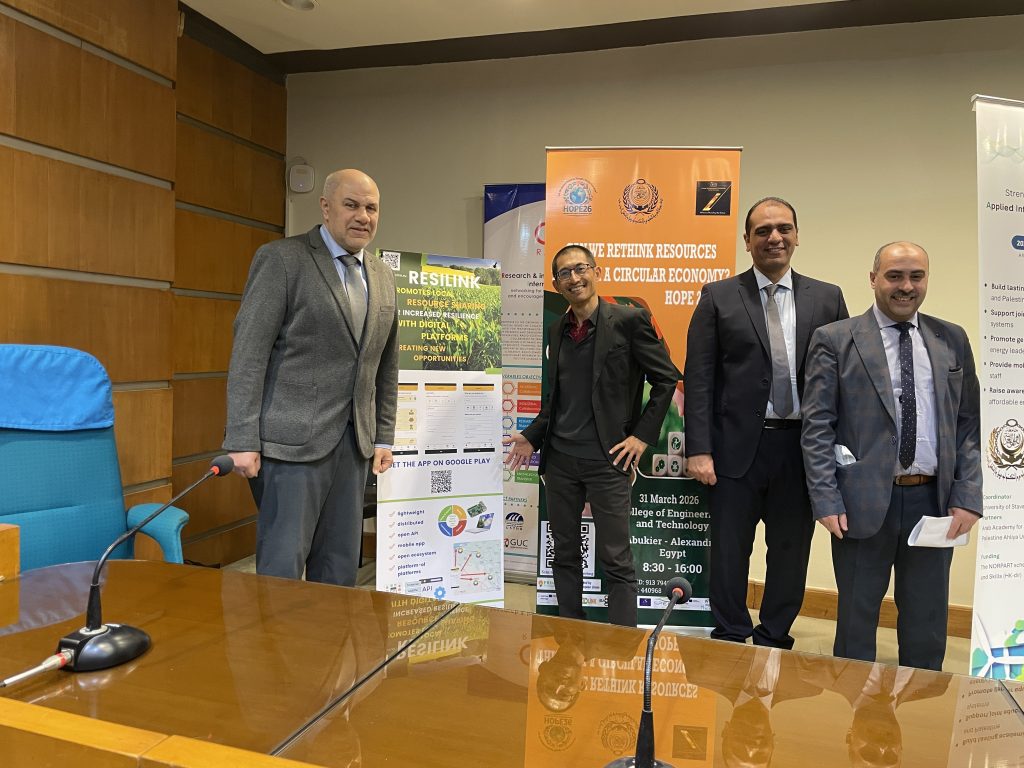
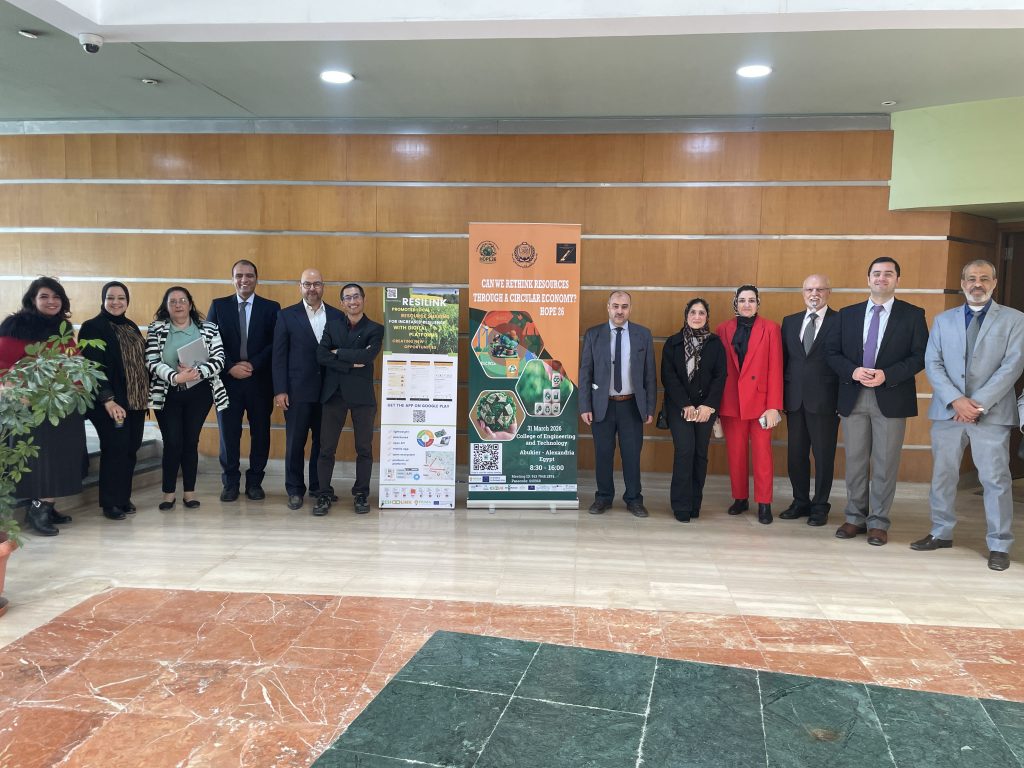
The first RESILINK’s Final Event in Egypt took place at AASTMT’s campus in Alexandria, as part of the HOPE26 workshop held in hybrid mode. The event has been organized by AASTMT partner and was a great opportunity for the whole RESILINK consortium to acknowledge the participation and the engagement of farmers in the Evaluation Program and the Living-Lab program run by RESILINK. See https://resilink.eu/dissemination-acknowledgment-at-the-final-event-in-egypt.
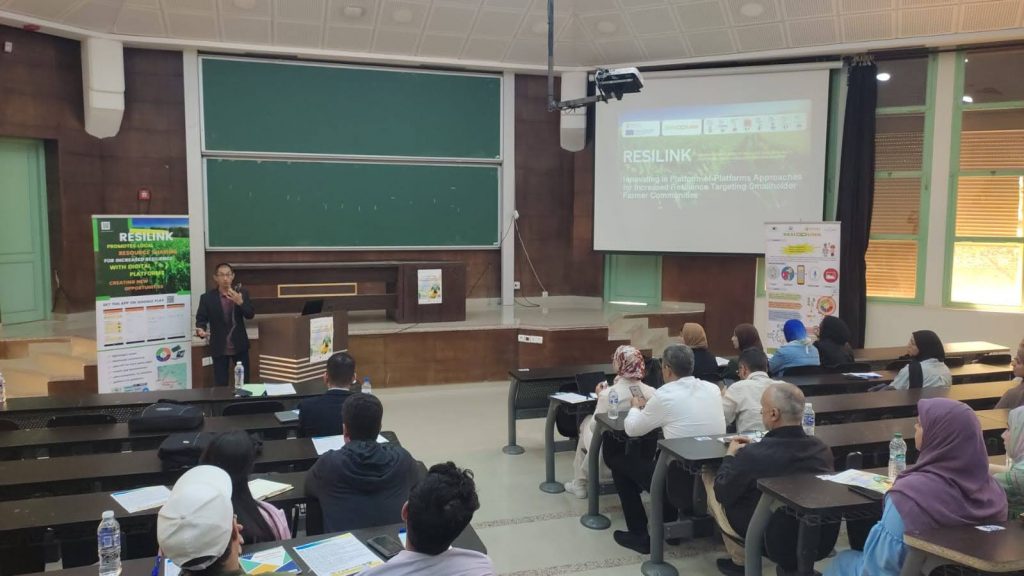
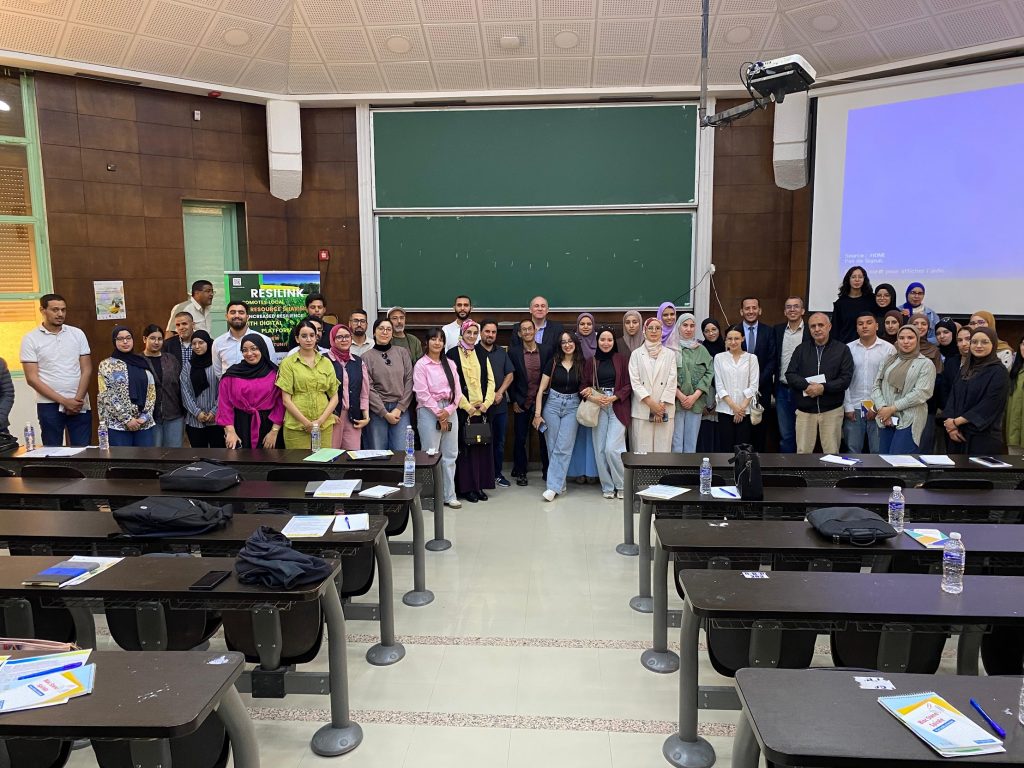
The second RESILINK’s Final Event in Morocco took place at University Sultan Moulay Slimane (USMS) in Beni-Mellal. The event entitled “Digital Innovation and Resilience in Agroecosystems: RESILINK in Action” has been organized by USMS partner and was a great opportunity for the whole RESILINK consortium to acknowledge again the participation and the engagement of farmers in the Evaluation Program and the Living-Lab program run by RESILINK. See https://resilink.eu/dissemination-acknowledgment-at-the-final-event-in-morocco.
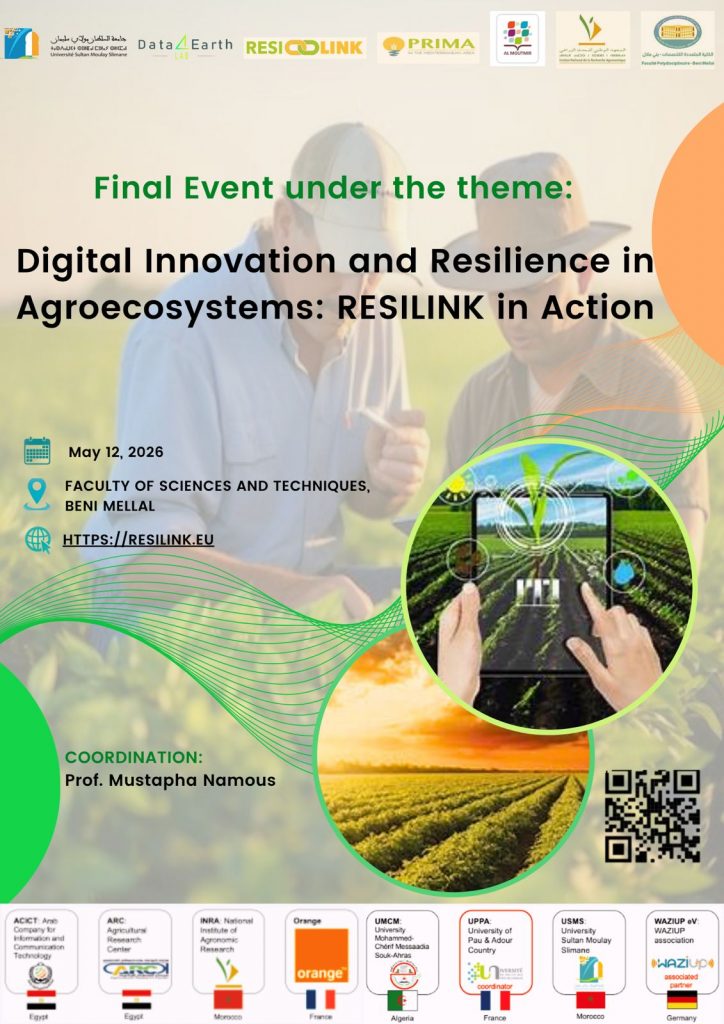
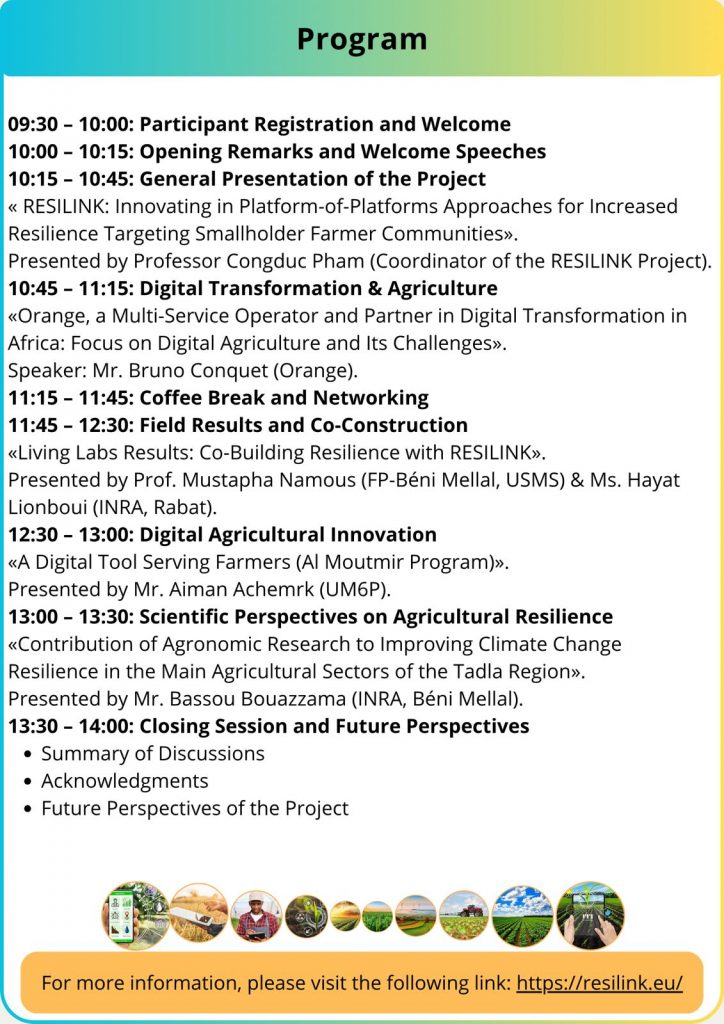
In addition to the 2 RESILINK presentations on “Innovating in Platform-of-Platforms Approaches for Increased Resilience Targeting Smallholder Farmer Communities” and “Living-Labs Results: Co-building Resilience with RESILINK“, Orange presented their broad activities in Africa in a presentation entitled “Orange, multi-service operator, partner in digital transformation in Africa: Focus on digital agriculture and its challenges“. It was the opportunity for Bruno Conquet from Orange Innovation to announce that during a meeting with Orange Guinea in Guinea (Conakry) in the end of 2025, the interest in the RESILINK application concept, look & feel was high to create a “Marketplace” application. The RESILINK approach and service will therefore be adapted for Orange Guinea.
An invited presentation on the “Al Moutmir Initiative and Program” was also given by Aiman Atchemrk from UM6P. It was a great moment of exchange on the valuable multi-year experience on increasing capacity-building and innovation with digital tools with smallholder farmer communities!
SUMMARY OF MAIN RESULTS
The RESILINK Digital Platform that consists in the RESILINK backend server and the RESILINK frontend mobile application are fully functional. The RESILINK server implements the “platform-of-platforms” approach which is one of the main contributions of the RESILINK project: (i) the server is very lightweight and can be deployed out-of-the-box on laptops or even single board computers such as a Raspberry Pi, (ii) deployment of several lightweight RESILINK servers is made possible where each server could have a geographical scope to efficiently manage crisis in a very local manner, (iii) incremental deployment of servers can then provide a very high level of flexibility, (iv) and finally, the full platform-of-platforms approach is enabled with the RESILINK open API allowing fast development and deployment of third-party platforms based on RESILINK.
The RESILINK mobile application is available on the Google Play Store for download and immediate testing. The development of the mobile application went through several phases and versions that were continuously improved for the Evaluation Program and the Living Lab Program.
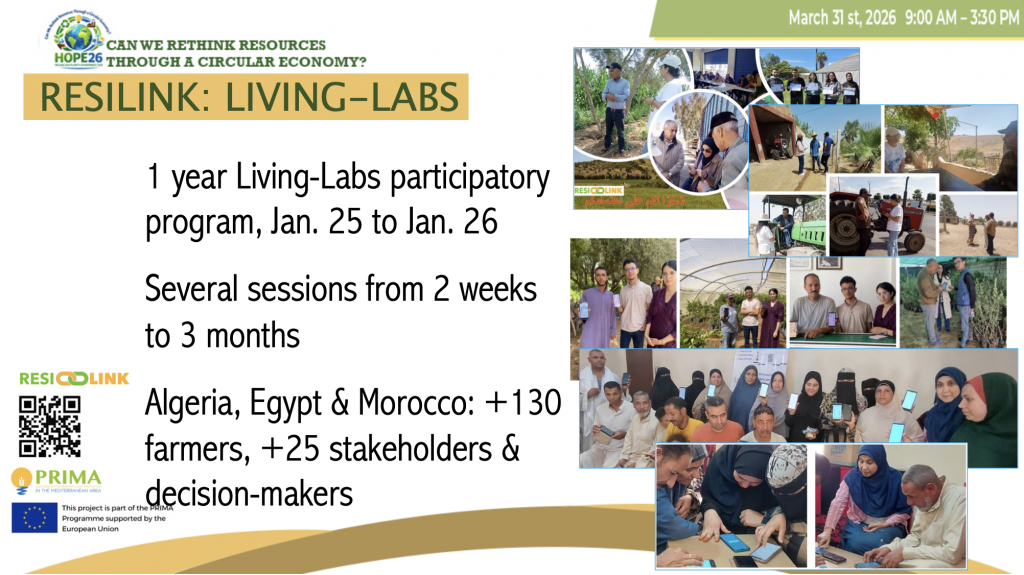
The Living Lab Program ran for 12 months from January 2025 to January 2026. Prior to the Living Lab Program, several interviews and survey sessions, that were followed by a large scale Evaluation Program, have been conducted to raise awareness, test & validate the proposed functionalities and collect feedback from farmers in order to maximize technology adoption.
In order to validate the open API and the platform-of-platforms approach, Orange developed the LocKitSolar demonstration application showcasing how to leverage the RESILINK API for building a solar product marketplace. Orange Guinea also expressed interest in the RESILINK application concept to create a “Marketplace” application. The RESILINK approach and service will therefore be adapted for Orange Guinea.
ALL THE IMPORTANT DELIVERABLES!
- WP1. D1.1 Smallholders’ resource requirements and distribution channels in a local & territorial agri-food chain.
- WP1. D1.2b Final report on Framework for a generalized resource sharing for increased resilience of smallholder considering a local & territorial agri-food chain.
- WP2. D2.1b Final report on user requirements, user interface and co-design of the RESILINK generalized resource sharing digital platform.
- WP2. D2.2c RESILINK resource sharing digital platform – v3. Get also the companion document D2.2c-Annex that describes in detail the installation procedures for all RESILINK platform components.
- WP2. D2.4b Final report on test and validation of the full RESILINK framework.
- WP4. D4.2b Final report on software templates demonstrating RESILINK’s open API.
- WP5. D5.3c Synthetic Report on 3 years of Smallholder Living-Lab Piloting Program and large-scale evaluation.
SOCIO-ECONOMIC IMPACT OF THE PROJECT
The RESILINK project has generated socio-economic impacts beyond the development of its digital platform and mobile application, particularly in terms of digital ecosystem development, technology adoption by smallholders, and new research and innovation perspectives.
A significant achievement is the validation of the RESILINK open API and platform-of-platforms approach. The functional LocKitSolar demonstrator has shown how the API can be reused to develop applications for other domains, while the interest expressed by Orange Guinea in adapting the RESILINK approach to an agricultural marketplace provides a concrete perspective for further exploitation. These results support the development of a more open ecosystem of digital platforms, reducing isolation between platforms, facilitating interoperability and encouraging the reuse and sharing of digital services and functionalities rather than the development of isolated and competing solutions.
The project has also provided clear evidence that appropriately adapted digital solutions can be adopted and used by smallholder farmers. The interviews, surveys, Evaluation Program and Living Lab activities enabled continuous interaction with farmers and local partners and ensured that the solution was progressively adapted to their needs and practices.
Several scientific publications resulting from the project have opened new research and innovation perspectives, particularly concerning participatory approaches to the design and adoption of digital agricultural services. RESILINK has also contributed to an interdisciplinary approach, bringing advanced ICT concepts such as distributed platforms, open APIs and digital resource management into interaction with agricultural and socio-economic research.
Although the initially planned commercial partnerships and mentoring activities were not implemented, the project has established a strong foundation for further exploitation. Further actions will nevertheless be necessary to increase the visibility and adoption of the RESILINK mobile application and achieve genuine large-scale deployment, including continued dissemination, stakeholder engagement and the identification of appropriate exploitation and business models.
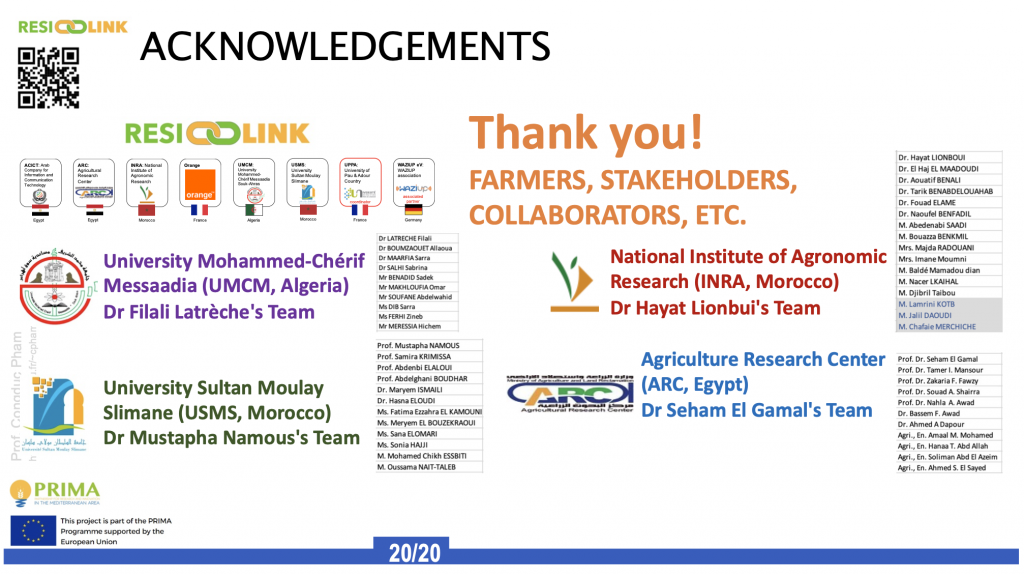
CONCLUSIONS & ACKNOWLEDGEMENTS
The RESILINK project has successfully achieved its overall objectives, resulting in a fully functional digital platform and mobile application designed to strengthen the resilience of smallholders by facilitating access to local agricultural resources, services and markets. Beyond the technical development, a key factor in the success of the project was the strong engagement of the local partners and their close interaction with farmers throughout the project. Interviews and survey sessions conducted by the local partners provided valuable insights that directly informed the design and progressive improvement of the RESILINK mobile application. The subsequent Evaluation and Living Lab Programs validated these initial findings in real conditions and allowed feedback from farmers to be continuously incorporated into successive versions of the application.
The feedback collected throughout the evaluation activities has been very positive. In particular, the latest version of the RESILINK mobile application has been well received by participating farmers, who considered it intuitive and easy to use. The availability of an Arabic-language interface was also particularly positively perceived. This feature proved important for making the application more accessible to local users, reducing language-related barriers for technology adoption.
The project also demonstrated the technical feasibility and flexibility of the RESILINK platform-of-platforms approach. The lightweight architecture, open API and possibility of deploying geographically distributed instances provide a flexible foundation for adapting the solution to different territories, use cases and local ecosystems.
Overall, RESILINK has demonstrated that successful digital innovation for smallholders depends not only on the underlying technology, but also on a strong understanding of local needs and sustained engagement with end users. The close involvement of local partners and farmers throughout the interviews, surveys, evaluation and Living Lab activities was therefore a central element of the project’s success. The resulting platform and mobile application provide a validated technological foundation for further exploitation.